Sunday, September 8, 2013

Gros Morne has spectacular scenary, but it is important for other reasons. One is the Tablelands, where the earth's mantle was pushed up on top of the crust when the tectonic plates collided 400-500 million years ago.


A great deal has eroded since but what remains is informative. As you can see especially in this last picture the land is barren. The rocks of the mantle are more dense than the crust's rock and have minerals in different proportions. This makes the land poisonous to most plants. This area help geologists formulate the tectonic plate theory that we all take for granted today.

Another important site is Green Point, which doesn't look like much, especially on a gray windy day. It is an area of shale and limestone deposits that  were laid down on the bottom of a tropical sea milliions of years ago. In the year 2000, one of these hundreds of layers was designated the global stratotype for the Cambrian / Ordovician boundary in geologic time, as the conodont Iapetognathus Fluctivagos first appeared here approximately 492 million years ago. Yes, I had to copy that in order to get it right.

We were told that the distance between my feet was the deposits from about 60,000 years

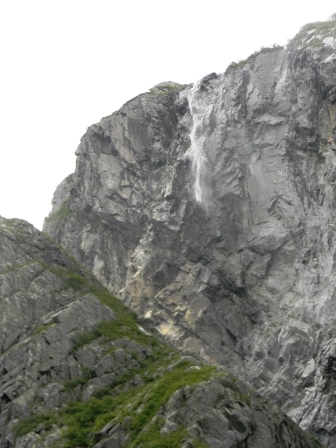
But of course the magnificent scenery is the biggest draw


Thursday, September 5, 2013

Yesterday it was raining so we drove north to the tip of Newfoundland to see a site where a Viking landing has been found. The Vikings did not try to settle here, but used the place for about ten years as a base camp to overwinter and to spread out to gather wood, grapes and furs and then to return to Greenland and Iceland and home to trade.
The landing spot


There were nine or ten of these very distinct hollows that have been dug up and then restored.


Four buildings have been reproduced. The large building served as the main living quarters for a 35-40 person crew with the wives and wives' servants (slaves) of the two or three most prominent crew members.


This was not at the Viking site but something we saw along the highways on the way. We would be miles from any little village or even a house, and see these fenced off areas usually no more than 10 feet off the road. The plots were about 20X20 to 20X40 and sometimes there were 3 or 4 next to each other. They had potatoes planted in almost every one, but some had a variety of vegetables. None of the fences looked as if they would stop any animal, though some looked a little sturdier than others. 

Gros Morne National Park in Newfoundland. What can I say, the pictures will not do it justice.
On the way to Gros Morne

Also on the way


Most of these were taken either in the way to or at Western Brook Pond where we took a boat tour to the end of the lake. This lake is a cut off fjord, which means it was a fjord cut by thousands of years of glacier action, then about 9000 years ago the glaciers melted and the land rebounded so that this lake no longer has any salt water, only a single small brook that drains it very slowly. 

Tuesday, September 3, 2013

Acadian historical Village.

On Saturday we spent most of the day at the Acadian historical village. The Acadians are the French that settled in what is now New Brunswick, Nova Scotia and Maine in the 1600's. France and England fought over the provinces for almost 200 years, before England and then Canada go the Maritimes and the US got Maine. The Acadians in New Brunswick don't seem to identify much with Quebec. They were very poor and isolated until the middle of the last century. The government tried to forcibly assimilate them by requiring schools only teach in English and not include any religious (read Catholic) education. From several of the docents at the history village we got the impression they are still fighting this battle in their souls. We talked to some English speaking New Brunswick citizens later at our campground and they indicated that the Acadians were trying to remain isolated and did not encourage children to become educated and move beyond the small community. Anyway the village was interesting.

View of the coast as we drove to the Village

Huge church on the way to the village

Another coast view

These pictures from the village are especially for Sherry Archer and Jeanne Leser
Here they are taking the plant part of the flax and with this they beat the stalks to separate the fibers. 

Then the fibers are taken to the table on the right where they are repeatedly drawn thru a board that looks like it has a bunch of square nails with points up in lines. This makes the fibers separate even more. Then they are spun into thread.

Here the thread is woven into cloth

This is a shirt made from the material. Men and boys wore the shirts which would last for 8-10 years of daily wear. They also made bed linens which they claim never wore out. Each washing made the material softer. 
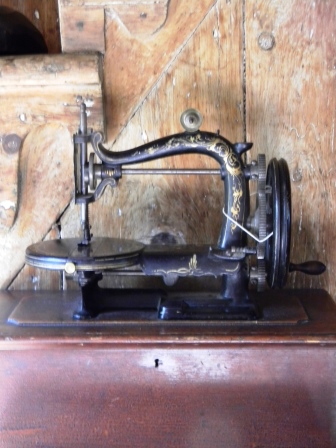
I love this very old sewing machine.

This shows the two types of spinning wheels they used for spinning wool. The larger is the more primitive. The wheel had to be turned by hand so the woman wouldhave to stand the entire time. The smaller one has a pedal to turn the wheel.

This is for Tom, a hand powered mortiser.

Drive to New Brunswick

On Friday the 30th we left La Maurice and started toward New Brunswick. Along the way we stopped first at an apple orchard and fruit stand. They did have freshly picked apples, but they also had freshly picked Strawberries and blueberries. Such a difference from Arkansas. So we got tomatoes, strawberries, blueberries, apples, and a couple of flavored apple cider vinegar. Next we stopped a fromagerie. This particular cheese producer specialized in aged sheep cheeses. We bought three different varieties and I thought that would hold us for a couple of weeks, but it is almost gone. This is also the day that we first ran into the problem of chips embedded in credit cards. Evidently almost all of Canadian credit cards have these now and many gas station pumps will not take our credit card and we have to go in and pay. I guess these will be phased in at home in the next few years. One thing we noticed on this drive is that all of Canada except Quebec puts first English, then French on the highway signs, Quebec just puts French. This didn't bother us much, but when we were in construction zones and had no idea what we were supposed to be doing it was a bit unnerving.

Monday, September 2, 2013


Lake Wampacazonge

We arrived at La Maurice national Park On Wednesday, Aug 28. La Maurice is about half way between Montreal and Quebec. It is a park that is primarily known as a canoe and kayak park. On Thursday morning it was sprinkling a little so we drove around to see the whole park. One of the most interesting areas was a peat bog. Most of our peat comes from Canada. Peat bogs have lots of carnivorous plants which Tom really enjoyed.
Pitcher plant

We then picked one of the many lakes and went out in our kayaks.


The internet connection here is very slow. it has taken me all evening to upload these few pictures. I'll try to get the computer started on some more tomorrow before we go out and maybe be able to add some tomorrow night.